
Educating in an uncertain world – are we preparing children and young people for the world they will have to live in?
| PISA 2025 invites us to ask ourselves what it means to be well-educated today.
Critical thinking, creativity, and the ability to learn will be essential in a future of uncertainty. But we must also ask ourselves if everyone will have the same opportunities to develop them. In this Hablemos de…, we reflect on the challenge of educating for a world we still do not know. |
Educating has always meant, to some extent, preparing for the future. But few generations have had to do so in the face of a horizon as changing as the current one. Artificial intelligence, job transformation, disinformation, climate change, new ways of communicating, persistent inequalities, and a rapidly evolving knowledge form part of the world in which today’s children and young people will grow up. Faced with this reality, perhaps the most important educational question is no longer simply what they should learn, but what capabilities they need to develop in order to understand, decide, and act in a world that we cannot fully predict. The PISA 2025 results (Programme for International Student Assessment, promoted by the Organisation for Economic Co-operation and Development – OECD) are an international assessment that periodically analyzes the extent to which 15-year-old students can apply their knowledge and skills to real-life problems and situations.
In its 2025 edition, which surveyed more than 760,000 students in 91 countries and economies, the results offer some noteworthy signs: Average performance in reading and mathematics in OECD countries has reached its lowest levels ever recorded. One in five students exhibits low performance simultaneously in science, mathematics, and reading.
PISA 2025 brings something especially relevant: for the first time it incorporated the assessment of “learning in the digital world,” including the ability to solve problems using computational tools. Developing in digital environments does not only mean knowing how to use devices or applications. It also involves learning autonomously, exploring, selecting, and evaluating information, solving problems, and regulating the learning process itself.
This takes on particular importance in an era where an artificial intelligence tool can produce text, an image, an explanation, or an apparently convincing response in seconds. Accessing information no longer equates to having knowledge. Therefore, we need children and young people who are able to ask questions, verify sources, distinguish evidence from opinions, identify false or manipulated information, build arguments, and review their own conclusions. In short, we need critical thinking and, at the same time, creativity.
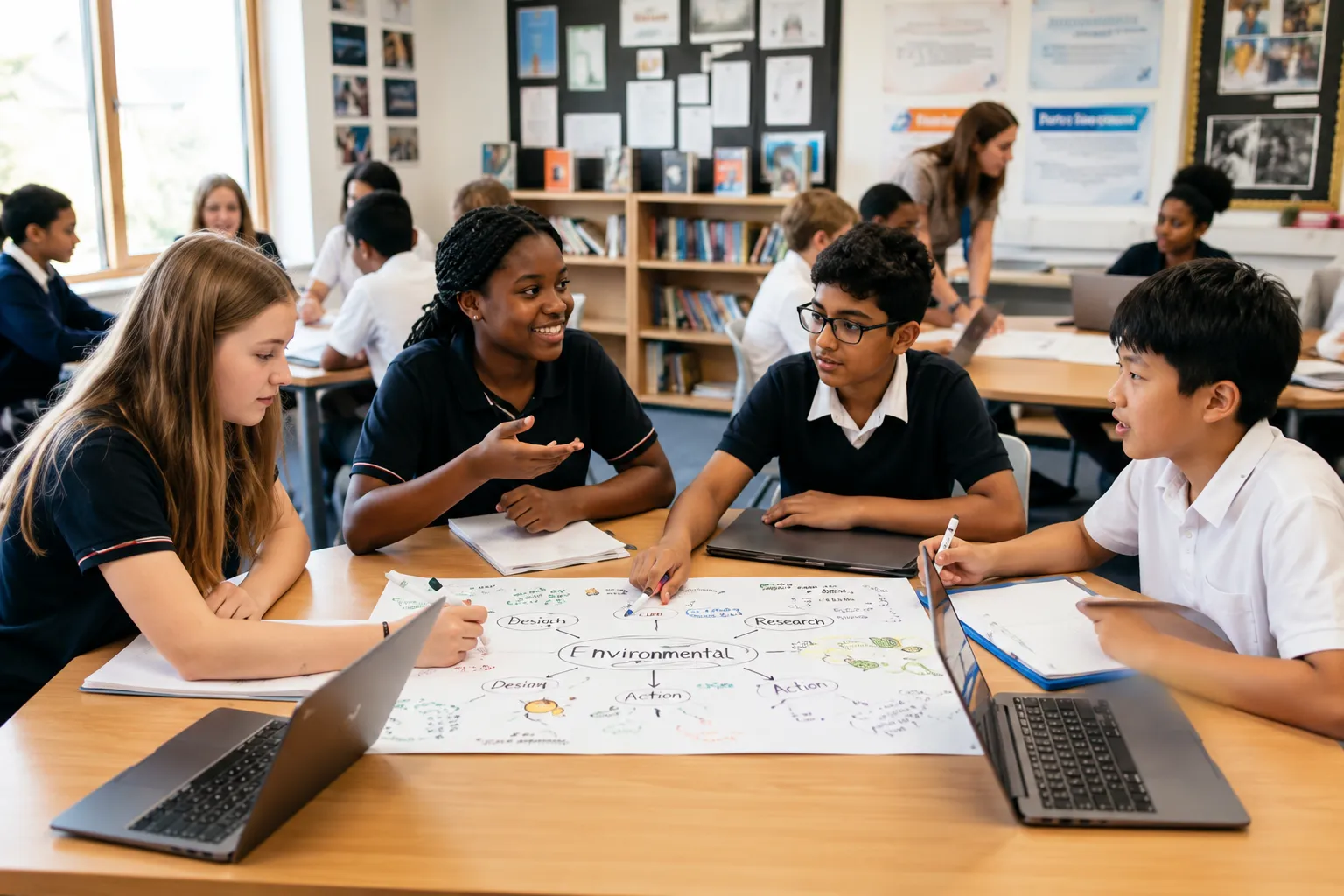
International evaluations have shown that creative thinking is not simply an innate quality reserved for certain individuals. Generating ideas, imagining alternatives, seeking different solutions to the same problem, and improving one’s own and others’ ideas are abilities that can be developed through education. In societies subjected to increasingly rapid technological, environmental, economic, and cultural changes, coping with new situations will be as important as mastering established knowledge.
We require not only reading comprehension, scientific reasoning, digital skills, problem-solving abilities, communication, collaboration, and socio-emotional skills. And we need a capacity that will be crucial in the coming decades: “learning to learn throughout life.” Education can no longer be conceived as a stage that ends when formal studies are completed. The transformations in knowledge and employment will require updating skills and continuing learning throughout the personal and professional life.
The expansion of artificial intelligence reinforces this need. UNESCO has warned that educating in the era of AI cannot be reduced to the technical mastery of new tools. Education maintains deeply human functions: developing autonomy, reflection, judgment, creativity, responsibility, and the ability to relate to other people and understand the world we share. The challenge is not to compete with machines, but to ask ourselves: What human capabilities should we strengthen precisely because we live surrounded by increasingly powerful technologies?
There is also a question that we cannot leave out of this conversation: equity. The opportunities to develop these skills are not distributed equally. PISA continues to show a significant relationship between socio-economic conditions and educational outcomes. Cultural and technological resources, school conditions, the family environment, and the opportunities available in each territory continue to influence educational trajectories. Preparing for the future cannot mean offering better opportunities only to those who already start from favorable positions.
Quality education must ensure that all children and young people, regardless of their social origin or family circumstances, have real opportunities to develop the skills they will need. “Educating for an uncertain world is also educating to reduce inequalities,” because those who have greater tools to understand, learn, and adapt will be better able to face their transformations.
Perhaps we should then broaden our idea of what it means to be well-educated. It is not a matter of choosing between knowledge and skills. Knowledge remains fundamental: we can hardly think critically about what we do not know. But simply accumulating information is not enough. Educating today means providing solid knowledge and, at the same time, teaching how to use it: understanding, relating, questioning, creating, solving, deciding, and acting.
We do not know exactly the world that the children and young people who are in our classrooms today will encounter. But we can contribute to developing the necessary skills to face it.
Preparing for uncertainty does not mean teaching people to guess the future. It means forming people who are capable of understanding it, adapting to it, and contributing to transforming it.
Asesórate Consultores Asociados
“Knowledge to understand. Capacities to respond. Education to transform”